
Having visited and admired numerous historical Roman Catholic churches across the Philippines, I thought I already knew what to expect—grand facades, stone bell towers, and familiar colonial designs shaped by centuries of Spanish influence. Yet standing before Paoay Church in Ilocos Norte felt entirely different.
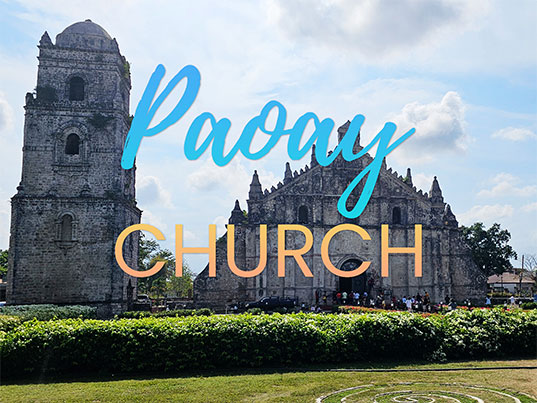
From the very first glance, it commands attention. Its massive structure, bold silhouette, and unusual proportions make it feel less like a traditional Filipino church and more like an ancient monument from another civilization altogether. In fact, its profile—especially when viewed from a distance—strikingly resembles the imposing stone temples of Cambodia, giving it an almost otherworldly presence.
A Church That Defies Expectations
Unlike the vertical elegance seen in many colonial churches, Paoay Church appears grounded, heavy, and immovable. Its thick coral-stone walls and wide stance create a powerful sense of permanence, as if the structure was designed not only to inspire faith, but to endure time itself.
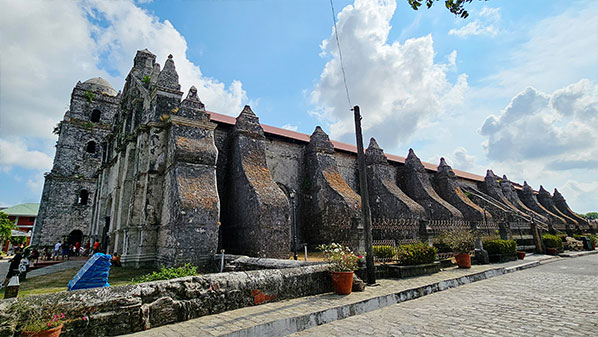
The most distinctive feature is its enormous buttresses—14 massive supports flanking the sides of the church. These are not merely decorative. They were engineered to absorb seismic shock, a necessity in an earthquake-prone region. This architectural style, known as Earthquake Baroque, sets Paoay Church apart from most churches in the country.
A Fascinating Blend of Cultures
What makes Paoay Church even more captivating is how it reflects a fusion of cultural influences. While fundamentally a Roman Catholic church built during the Spanish colonial period, its design incorporates elements that go beyond European traditions.
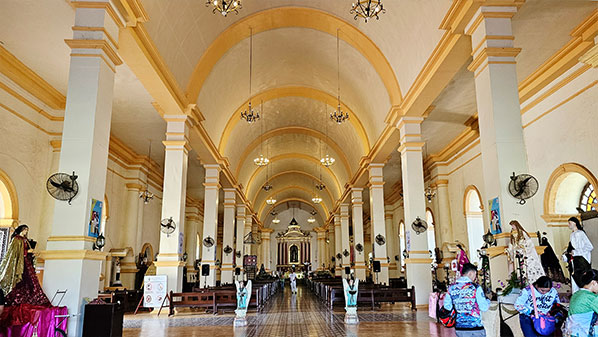
Hints of Chinese and Southeast Asian architectural styles can be seen in the curves, proportions, and overall massing of the structure. This blend may explain why its silhouette evokes comparisons to Cambodian temples—solid, symmetrical, and monumental rather than ornate and vertical.
Magnificent in Scale and Presence
Photos alone do not fully capture the experience of seeing Paoay Church in person. Its sheer size becomes truly apparent only when you stand at its base, looking up at walls that have withstood centuries of earthquakes, typhoons, and the relentless passage of time.

Despite its age, the church remains remarkably intact, exuding both strength and serenity. The weathered stone gives it character, while the open surroundings allow its form to dominate the landscape—simple, powerful, and unforgettable.
More Than Just a Church
Paoay Church is not just a place of worship; it is a testament to resilience, adaptation, and creativity. It represents how local builders responded intelligently to their environment, blending foreign influences with practical design to create something entirely unique.
Among the many historic churches scattered across the Philippines, Paoay Church stands in a category of its own. It doesn’t try to impress through ornate details or towering spires. Instead, it captivates through its strength, silhouette, and silent authority—a structure that feels ancient, majestic, and profoundly rooted in its land.
Final Thoughts About Paoay Church
Traveling through the Philippines often reveals familiar patterns in colonial architecture, but this church breaks that pattern beautifully. It reminds us that history is not uniform, and that even within shared traditions, extraordinary exceptions exist.
If you’ve seen countless churches and think you’ve seen them all, Paoay Church will prove you wrong. Its distinctive form, fascinating design, and commanding presence make it one of the most remarkable—and memorable—churches in the country.
Frequently Asked Questions
It looks different because it was built in the Earthquake Baroque architectural style. Its massive stone walls and large buttresses were designed to withstand strong earthquakes, giving it a wider, heavier, and more grounded appearance compared to most colonial churches.
It is famous for its Earthquake Baroque architecture, a style developed in earthquake-prone regions. This design emphasizes thick walls, low height, and strong buttresses to improve structural stability.
The church’s wide stance, massive proportions, and solid silhouette resemble Southeast Asian temple structures. Its design also reflects a blend of Spanish, Chinese, and local influences, making it visually distinct from typical European-style churches.
Yes, Paoay Church is a UNESCO World Heritage Site. It is one of the four Baroque Churches of the Philippines, recognized for its historical, architectural, and cultural significance.
Construction of Paoay Church began in 1694 and was completed in 1710. It has survived centuries of earthquakes and natural disasters due to its innovative architectural design.
There is no mandatory entrance fee, but donations are encouraged to help with maintenance and preservation.
It is located in the town of Paoay, Ilocos Norte, Philippines, and is a popular stop on Ilocos travel itineraries.